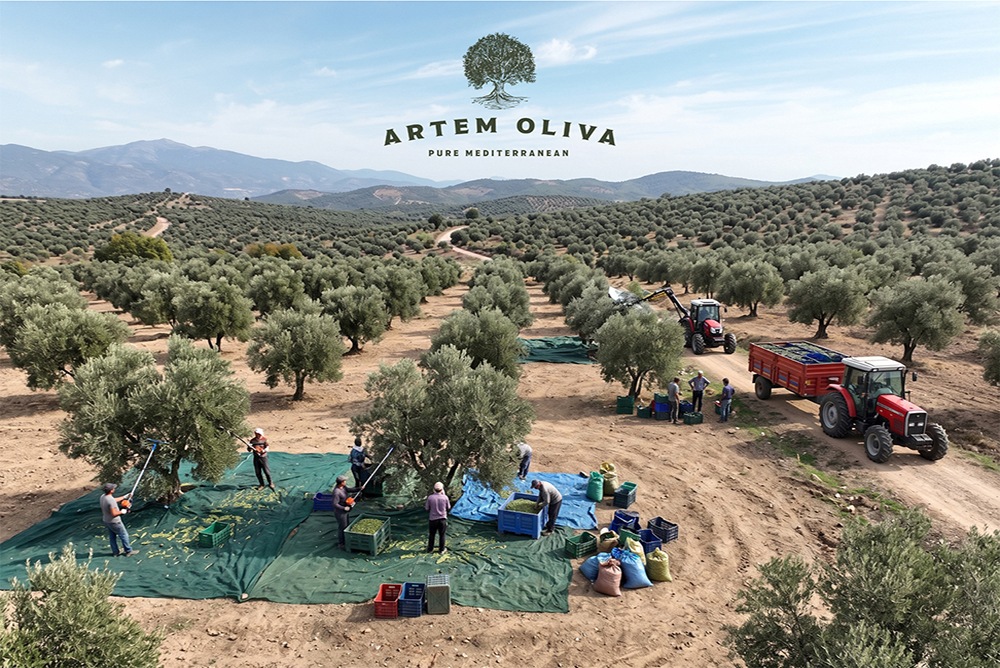
Updated on 17 November 2026 with the latest harvest estimates. Türkiye is now well into the 2026/2027 olive harvest, and the crop estimates have moved higher since the season opened. The National Olive and Olive Oil Council (UZZK) expects 4,030,000 tons of olives, about 64% more than last season’s 2.45 million tons. The second 2026 crop estimate of the Turkish Statistical Institute (TÜİK), published on 23 October, is higher still at around 4.3 million tons, a 75.5% increase. Either figure would be the largest olive crop in the history of the Republic, clearly above the previous record of 3.75 million tons set in 2024. Both are still estimates, so the record will only be confirmed once the harvest is complete.
Picking is under way across the Aegean and Marmara regions, and producers, exporters and buyers are asking the same question: what will a crop this large mean for olive oil volumes, prices and exports?
Why This Season Is So Big: The “On-Year” Effect
Olive trees naturally alternate between heavy and light crops. The 2025/2026 season was an “off year”, and spring frost and summer drought made it worse. The National Olive and Olive Oil Council (UZZK) estimated last season’s crop at 2.45 million tons, about 35% below the year before.
Trees that carry little fruit one year store energy for the next. That is why 2026 is an “on year” (var yılı), with heavily loaded branches across the Aegean and Marmara regions.
The second driver is structural. Türkiye now has around 200 million olive trees. Fifteen years ago there were about 90 million traditional trees, and roughly 110 million have been planted since. Many of those newer groves are now reaching full bearing age, so each on-year sets a higher ceiling than the last.
Sources: TÜİK (2022/2023 to 2024/2025), UZZK (2025/2026 and the 2026/2027 estimate).
Olive Oil and Table Olive Expectations
UZZK’s season estimate puts olive oil output at 588,000 tons, far above the 310,000 tons estimated for 2025/2026 and well beyond the 400,000 tons or so that the industry expected when the season opened. Table olives are estimated at 1,163,000 tons, up from 740,000 tons last season, and the remaining 2,867,000 tons of fruit are expected to go to the mills. On these figures Türkiye remains the world’s leading table olive producer and the second-largest olive oil producer after Spain, with ample supply in every size grade.
| Season | Total olives | Table olives | Olive oil |
|---|---|---|---|
| 2024/2025 | 3,750,000 t Record to date | — | — |
| 2025/2026 | 2,450,000 t | 740,000 t | 310,000 t |
| 2026/2027 Estimate | 4,030,000 t | 1,163,000 t | 588,000 t |
Sources: TÜİK (2024/2025), UZZK (2025/2026 and 2026/2027). 2026/2027 figures are UZZK estimates; TÜİK's second estimate for total olives is around 4.3 million t.
Sources: TÜİK (2024/2025), UZZK (2025/2026 and 2026/2027). 2026/2027 figures are UZZK estimates; TÜİK’s second estimate for total olives is around 4.3 million t.
These figures describe the fruit on the trees, not the oil in the tanks, and UZZK itself warns that the olive oil estimate may not be reached. There are two reasons. First, oil yields are low this year: the 588,000-ton figure assumes the usual 1 kg of oil from 5 kg of olives, while mills are currently getting 1 kg from 6 to 10 kg. Second, farm-gate prices are below production cost. Olives sell for 20–35 TL per kg against a cost of 50–70 TL, and olive oil for 170–200 TL per kg against a cost of 240–280 TL, so fallen fruit and thinly loaded trees on difficult terrain may not be picked at all. If that fruit is left in the groves, UZZK says the final crop could be 30–50% below the estimate.
Regional Snapshot: Marmara and the Aegean
The Marmara region, home of Türkiye’s famous Gemlik-type black table olives, is set for a strong year:
- Gemlik expects 60,000–65,000 tons of olives from about 2.4 million trees: roughly 35,000 tons of table olives, 28,000 tons of oil olives and about 7,000 tons of olive oil.
- Orhangazi expects around 70,000 tons from about 2.23 million trees, almost back to 2024 levels.
In the Aegean, the heart of Türkiye’s olive oil production, harvest continues through November and December, and how much of the fruit is picked there will largely decide the final olive oil figure.
Export Outlook: From a Weak Year Toward a $1 Billion Target
The 2025/2026 export season ended on a weak note for olive oil. In the first eleven months of the season (1 November 2025 to 30 September 2026), Türkiye’s olive oil exports were worth about $105.7 million, down roughly 57% from $243.9 million a year earlier, as lower world prices and domestic market measures weighed on shipments. Table olives held up far better: the season from 1 October 2025 to 30 September 2026 closed at 89,544 tons and $241.2 million, against a record 100,746 tons and $255 million the season before.
The Aegean Olive and Olive Oil Exporters’ Association aims to bring sector exports back to $1 billion and above. Its strategy rests on:
- moving from bulk toward branded and packaged products with higher added value
- a digital traceability system for olive oil now in development
- efforts to lift the EU’s 100-ton quota on Turkish olive oil
The United States remains a key destination, taking about 28% of Türkiye’s olive oil exports.
Conclusion
The 2026/2027 season is shaping up as a historic on-year for Turkish olives. A crop estimated at 4.0 to 4.3 million tons, potential olive oil output of up to 588,000 tons and softening prices put Türkiye back in a strong position on the world market. How much of that fruit is actually picked and pressed is the open question of the season. For buyers, it is a season of wide choice, competitive pricing and plenty of fresh-crop supply.